🔔   650TH YEAR CELEBRATIONS OF MANAVALA MAMUNIGAL  ·  Sri Ramanujaya Namaha  ·  Register Now for Upcoming Events  ·  Srinivasa Mangalam  ·  Sri Varavara Munaye Namaha   🔔
✦   SMT RAMANUJA SIDDANTHA SABHAI (Regd.)   ✦
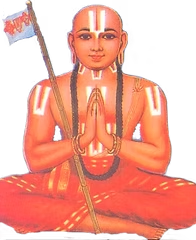
Sri Ramanuja

SMT RAMANUJA
SIDDANTHA SABHAI

Sri Ramanuja Siddhanta Sabhai is a religious and spiritual organization dedicated to propagating the philosophical teachings (Siddhanta) of Ramanuja, the great theologian and proponent of Vishishtadvaita philosophy.

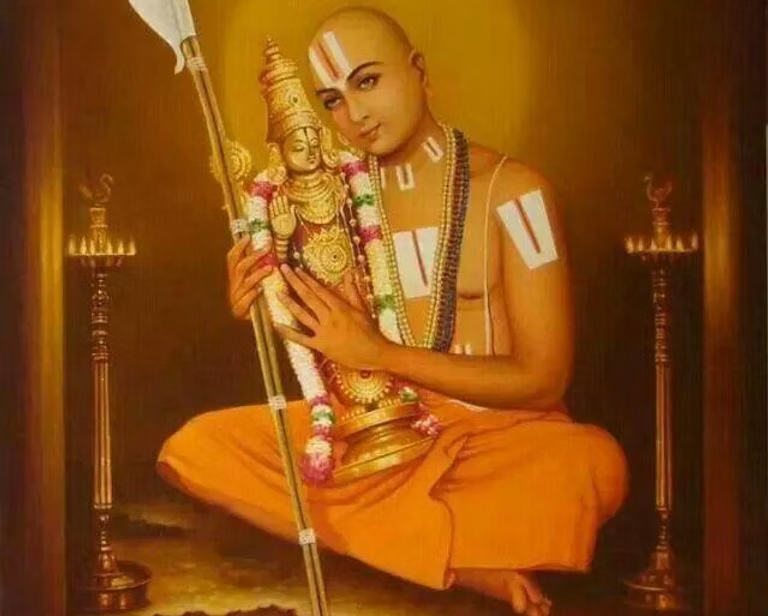
About Sri Ramanuja (1017–1137 CE)

Sri Ramanuja was a prominent Hindu philosopher and social reformer who systematized Vishishtadvaita Vedanta (Qualified Non-Dualism), emphasizing devotion (Bhakti) to Lord Vishnu and advocating social equality in spiritual practice. He opened temple worship to all communities and strengthened the Sri Vaishnava tradition. He is especially associated with the Sri Ranganathaswamy Temple and the Melukote Cheluvanarayana Swamy Temple.

What is "Siddhanta"?

Siddhanta means established doctrine or philosophical conclusion. In the context of Sri Ramanuja's tradition, it refers to:

  • The teachings of Vishishtadvaita
  • The supremacy of Narayana (Vishnu)
  • The path of surrender (Prapatti)
  • Devotion combined with ethical living

Purpose of Sri Ramanuja Siddhanta Sabhai

Established around 1917 near the Kolar Gold Fields (KGF), our Sabha has been a beacon of Sri Vaishnava tradition for over a century. The Sabha is dedicated to:

  • Conducting Divya Prabandham recitations
  • Organizing Ramanuja Jayanthi celebrations
  • Conducting Vedic classes and religious discourses
  • Promoting Sri Vaishnava traditions
  • Maintaining temple administration and spiritual activities
  • Encouraging community unity and charity

Core Principles of the Sabhai

  • Devotion to Sriman Narayana
  • Following Ramanuja's Vishishtadvaita philosophy
  • Social harmony and inclusiveness
  • Preservation of Sri Vaishnava traditions
  • Spiritual education for younger generations

Ramanuja and His Philosophy of Vishishtadvaita

Sri Ramanujar (1017–1137 CE) is one of the most influential theologians of Indian philosophy and the foremost exponent of Vishishtadvaita (Qualified Non-Dualism). His system is a profound synthesis of metaphysics, devotion, and social ethics grounded in the Brahma Sutras, the Bhagavad Gita, and the Upanishads.

I. Meaning of Vishishtadvaita

The word Vishishtadvaita means:

  • Advaita – Non-dualism (Ultimate Reality is One)
  • Vishishta – Qualified or characterized

Thus, Reality is One, but this Oneness is qualified by diversity. God is One, but that One includes souls and matter as His attributes.

II. Core Ontological Structure: The Three Realities (Tattva-traya)

Ramanuja explains existence through three eternal realities:

1. Ishvara (God)

  • Supreme Being: Narayana / Vishnu
  • Omniscient, omnipotent, compassionate
  • Both material and efficient cause of the universe
  • Has auspicious qualities (kalyana gunas)

2. Chit (Individual Souls)

  • Conscious beings (Jivatmas)
  • Eternal but dependent on God
  • Capable of knowledge and bliss
  • Distinct yet inseparable from God

3. Achit (Matter)

  • Insentient matter (Prakriti)
  • Subject to change
  • Also dependent on God

Ramanuja compares this to the Body–Soul relationship: just as the body depends on the soul, the universe (souls + matter) depends on God. This is called Sharira–Shariri Bhava.

III. Concept of Brahman

Unlike Shankara's Nirguna Brahman (without attributes), Ramanuja insists that:

  • Brahman has infinite auspicious qualities
  • Brahman is personal
  • Brahman is accessible through devotion

For Ramanuja, God is not abstract consciousness but a loving, personal deity.

IV. Doctrine of Bhakti (Devotion)

Bhakti is:

  • Loving meditation on God
  • Continuous remembrance
  • Emotional and intellectual surrender

Bhakti is not mere ritual but deep spiritual engagement.

V. Doctrine of Prapatti (Total Surrender)

One of Ramanuja's most revolutionary contributions is Prapatti (self-surrender). It includes:

  • Accepting what pleases God
  • Rejecting what displeases God
  • Faith that God will protect
  • Feeling of helplessness
  • Complete surrender

Prapatti is open to all people, regardless of caste or gender.

VI. Concept of Liberation (Moksha)

According to Ramanuja:

  • Liberation means eternal service to God in Vaikuntha.
  • The soul does not merge and lose individuality.
  • The liberated soul retains identity and enjoys divine bliss.

This differs from Advaita, where liberation means dissolution into Brahman.

VII. Epistemology (Means of Knowledge)

Ramanuja accepts three valid sources of knowledge:

  • Perception (Pratyaksha)
  • Inference (Anumana)
  • Scriptural testimony (Shabda)

Scripture is the highest authority.

VIII. Ethical and Social Philosophy

Ramanuja was also a social reformer:

  • Opened temple worship to marginalized communities
  • Emphasized equality in devotion
  • Promoted inclusivity in spiritual practice
  • Opposed rigid caste discrimination in spiritual matters

His work helped democratize Hindu devotional religion.

IX. Major Works of Ramanuja

  • Sri Bhashya
  • Vedartha Sangraha
  • Gita Bhashya
  • Vedanta Sara
  • Vedanta Dipa

X. Comparison with Advaita

Aspect Shankara (Advaita) Ramanuja (Vishishtadvaita)
Nature of God Nirguna (without qualities) Saguna (with qualities)
World Illusory (Maya) Real
Soul Identical with Brahman Distinct but dependent
Liberation Merging Eternal service

XI. Philosophical Significance

Ramanuja's system:

  • Bridges reason and devotion
  • Preserves individuality within unity
  • Provides a theistic Vedantic framework
  • Integrates metaphysics with social ethics
  • Influenced Bhakti movements across India

XII. Central Siddhantas (Doctrinal Conclusions)

  • Brahman is personal and qualified.
  • Souls and matter are real and eternal.
  • The universe is the body of God.
  • Bhakti and Prapatti lead to liberation.
  • Liberation preserves individuality.
  • Devotion is open to all.

Important Texts of Ramanuja

Sri Ramanuja authored several foundational works that systematized Vishishtadvaita philosophy. These texts primarily interpret the Brahma Sutras, the Bhagavad Gita, and the Upanishads.

1. Sri Bhashya

  • His magnum opus.
  • A detailed commentary on the Brahma Sutras.
  • Establishes Vishishtadvaita as a systematic philosophical school.
  • Refutes Advaita (Shankara's interpretation).
  • Explains that Brahman is personal and qualified.

2. Vedartha Sangraha

  • A summary of the philosophical teachings of the Upanishads.
  • Harmonizes seemingly contradictory Vedic statements.
  • Clarifies the nature of Brahman, soul, and universe.
  • Considered a key theological foundation of Sri Vaishnavism.

3. Gita Bhashya

  • Commentary on the Bhagavad Gita.
  • Emphasizes Bhakti (devotion) and Prapatti (surrender).
  • Presents Krishna as the Supreme Brahman.
  • Accessible and devotional in tone.

4. Vedanta Sara

  • A shorter treatise summarizing key Vedantic doctrines.
  • Written in a concise and systematic manner.
  • Serves as an introductory manual to Vishishtadvaita.

5. Vedanta Dipa

  • A brief commentary on the Brahma Sutras.
  • Simpler than Sri Bhashya.
  • Often studied alongside Sri Bhashya.

6. Nitya Grantham

  • A practical manual for daily worship.
  • Explains rituals, meditation, and devotional practices.
  • Important for temple and household spiritual life.

Other Important Associated Texts

Though not authored by Ramanuja himself, these are central to his tradition:

  • Divya Prabandham – 4000 Tamil hymns of the Alvars
  • Bhagavata Purana
  • Upanishads (especially Chandogya and Brihadaranyaka)

Summary of His Textual Contribution

Ramanuja's writings:

  • Systematized Vishishtadvaita philosophy
  • Provided a theistic interpretation of Vedanta
  • Made devotion intellectually rigorous
  • Integrated philosophy with temple worship

Divya Prabandham

Nālāyira Divya Prabandham – The 4000 Sacred Tamil Hymns

The Divya Prabandham is the central devotional scripture of the Sri Vaishnava tradition. It consists of 4000 Tamil hymns composed by the twelve Alvars (Vaishnava poet-saints) between the 6th and 9th centuries CE. It is regarded as the "Tamil Veda" because it conveys Vedic truths in devotional Tamil poetry.

1. The Alvars (Authors of the Hymns)

The twelve Alvars include:

  • Poigai Alvar
  • Bhoothath Alvar
  • Pey Alvar
  • Tirumazhisai Alvar
  • Nammalvar
  • Madhurakavi Alvar
  • Kulasekara Alvar
  • Periyalvar
  • Andal
  • Thondaradippodi Alvar
  • Tiruppaan Alvar
  • Tirumangai Alvar

Among them, Nammalvar is considered the most philosophically profound, and Andal is the only female Alvar.

2. Compilation of the Prabandham

The hymns were compiled by Nathamuni, who recovered and organized the 4000 hymns into a structured canon, preserving them for temple liturgy.

3. Important Sections of the Divya Prabandham

Some major components include:

✦ Tiruvaymozhi (by Nammalvar)

  • 1102 verses
  • Philosophical and mystical
  • Often compared to the Upanishads

✦ Tiruppavai (by Andal)

  • 30 verses
  • Sung during the Margazhi month
  • Expresses devotional surrender to Krishna

✦ Periyalvar Tirumozhi

  • Focuses on maternal devotion toward Krishna

✦ Amalanadipiran (by Tiruppaan Alvar)

  • Describes the divine beauty of Lord Ranganatha

4. Philosophical Importance

The Divya Prabandham:

  • Emphasizes Bhakti (devotion)
  • Teaches Prapatti (total surrender)
  • Describes the soul's dependence on God
  • Celebrates Vishnu in 108 Divya Desams (sacred temples)

It deeply influenced the theology of Ramanuja, who elevated these Tamil hymns to scriptural authority equal to the Sanskrit Vedas.

5. Temple and Ritual Importance

The Divya Prabandham is:

  • Recited daily in Sri Vaishnava temples
  • Central to festivals in Sri Ranganathaswamy Temple and Melukote Cheluvanarayana Swamy Temple
  • Sung during Adhyayana Utsavam (annual recitation festival)

6. Why It Is Called the "Tamil Veda"

  • Conveys Vedic philosophy in Tamil
  • Makes spiritual knowledge accessible to all castes
  • Combines poetry, philosophy, and devotion
  • Bridges Sanskrit Vedanta and Tamil Bhakti tradition

7. Core Themes

  • Divine love for Vishnu
  • Soul's longing for union with God
  • Surrender (Sharanagati)
  • Praise of sacred temples
  • Emotional mysticism

In Simple Words: The Divya Prabandham is the heart of Sri Vaishnavism. If Ramanuja systematized the philosophy intellectually, the Alvars expressed it emotionally and poetically.

The Sacred Divya Prabandham – The Tamil Veda

The Divya Prabandham (Nālāyira Divya Prabandham) is a collection of 4000 sacred Tamil hymns composed by the twelve Alvars, the great Vaishnava poet-saints of South India. Written between the 6th and 9th centuries CE, these hymns express deep devotion to Lord Sriman Narayana and form the spiritual foundation of the Sri Vaishnava tradition. Compiled and preserved by the revered Acharya Nathamuni, it is lovingly called the "Tamil Veda", conveying the profound truths of the Vedas in the sweet and accessible language of Tamil.

Among the Alvars, Nammalvar is celebrated for his philosophical depth in the Tiruvaymozhi, while Andal — the only woman saint among them — is revered for her devotional masterpiece Tiruppavai, sung especially during the holy month of Margazhi. Ramanuja upheld these Tamil hymns with the same authority as the Sanskrit scriptures and integrated them into temple worship and theological study.

At Sri Bhagawat Ramanuja Siddhanta Prachar Sabha, the recitation and study of the Divya Prabandham continue as a sacred tradition. Through these hymns, devotees experience loving surrender (Prapatti), devotion (Bhakti), and the eternal bond between the soul and the Divine. The Divya Prabandham remains not only a scripture but a living spiritual heritage — uniting philosophy, poetry, and devotion in the service of Sriman Narayana.
Be updated on Sabha's activities

info@ramanujasiddnathasabha.org 97380 05131